
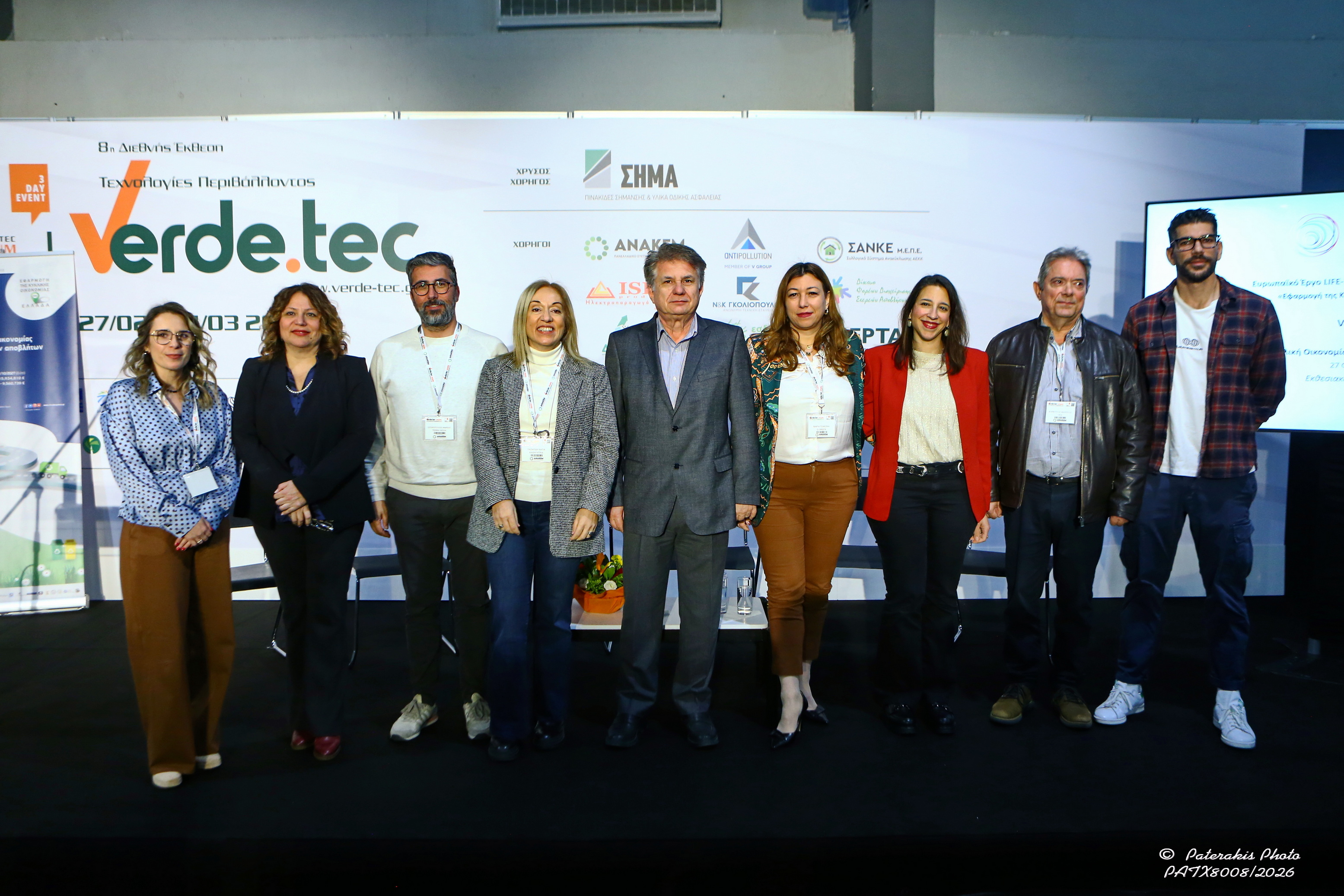
The workshop “Circular Economy and the LIFE IP CEI GREECE Project in Greece” was organized by the LIFE IP CEI GREECE project within the framework of the international exhibition Verdetec, on Friday, February 27, from 11:30 to 13:30.
The event aimed to present the latest results of the project’s actions, as delivered by its partners. Attendance exceeded all expectations, confirming the strong interest of institutions and businesses in the project’s initiatives, as the good practices being piloted can serve as a springboard for their implementation in municipalities and regions across the country.
The workshop opened with a presentation on the development of local and regional alliances for the management of agri-food waste within the framework of the project. The presentation was delivered by Ms. Maria Chr. Tsakona, Special Advisor to the Ministry of Environment and Energy, who highlighted the importance of utilizing the country’s significant potential of organic agri-food waste as part of the transition toward a sustainable production model based on circular economy principles. As she noted, the alliances already formed between stakeholders of the agri-food sector and the Ministry of Environment and Energy (which coordinates the project), along with the Management Plans developed, reveal both the structural challenges faced by the sector and the strong interest in transforming these wastes into valuable resources with multiple applications.
Dr. Filippos Kyrkítsos, Environmental Scientist and President of the Ecological Recycling Society, presented three models of integrated Green Points for Greek municipalities, developed through many years of research and practical implementation within the LIFE IP CEI GREECE project, taking into account the different characteristics of large and small municipalities. In a second part of his presentation: a) he proposed five measures to accelerate the implementation of the “Pay As You Throw” (PAYT) system in Greece, and b) he described a comprehensive Integrated Pay As You Throw system (I-PAYT) that can be adapted to local conditions in order to significantly reduce the time required for its implementation in Greek municipalities.
Next, Prof. Katia Lazaridi of Harokopio University presented the topic of food waste prevention as a value multiplier. Through specific examples of companies operating in Greece across different sectors of the food supply chain, she showcased practices and measures that have been successfully developed and implemented to prevent food waste generation, delivering significant economic, environmental and social benefits.
Representing Terra Nova, Mr. Andreas Sotiropoulos referred to the challenges of implementing Hazardous Household Waste (HHW) management systems in Local Government Authorities (LGAs). He presented both the obstacles faced by municipalities that hinder the implementation of separate HHW collection systems and the proposals that have emerged from the pilot implementation carried out within the project in the Municipality of Athens and the Region of Western Macedonia.
The Green Fund was represented by Ms. Zoe Gaitanarou, who spoke about the results of integrating circular economy technical specifications into funding instruments, underlining the importance of their use by local authorities and other stakeholders.
Among the municipalities participating in the project as partners, the Municipality of Vari-Voula-Vouliagmeni was represented by Dr. Miltiadis Kavrakos, Mechanical Engineer and Director of Climate Change at the Municipality. He presented the implementation of the “Pay As You Throw” system, the challenges that emerged during the transition to the new model, the benefits for citizens—who can now pay their municipal fees more fairly based on the quantity of waste they produce—as well as the implementation difficulties in the HoReCa sector, while also highlighting the overall positive results achieved.
The workshop concluded with the presentation of Dr. Asterios Stroumboulis, associate of the Hellenic Organization for Standardization (ELOT), who discussed the development of national standards for the circular economy. This important initiative enables the evaluation of organizations and actions based on commonly accepted standards developed within the framework of the LIFE IP CEI GREECE project.
The success of the event confirms that the circular economy is not only a new waste management model but a broader shift in mindset, capable of leading to substantial environmental benefits, resource savings, and the creation of new jobs.
The workshop was moderated by the project’s Communication Manager, Ms. Katerina Ladopoulou.
Read here the Press Release

