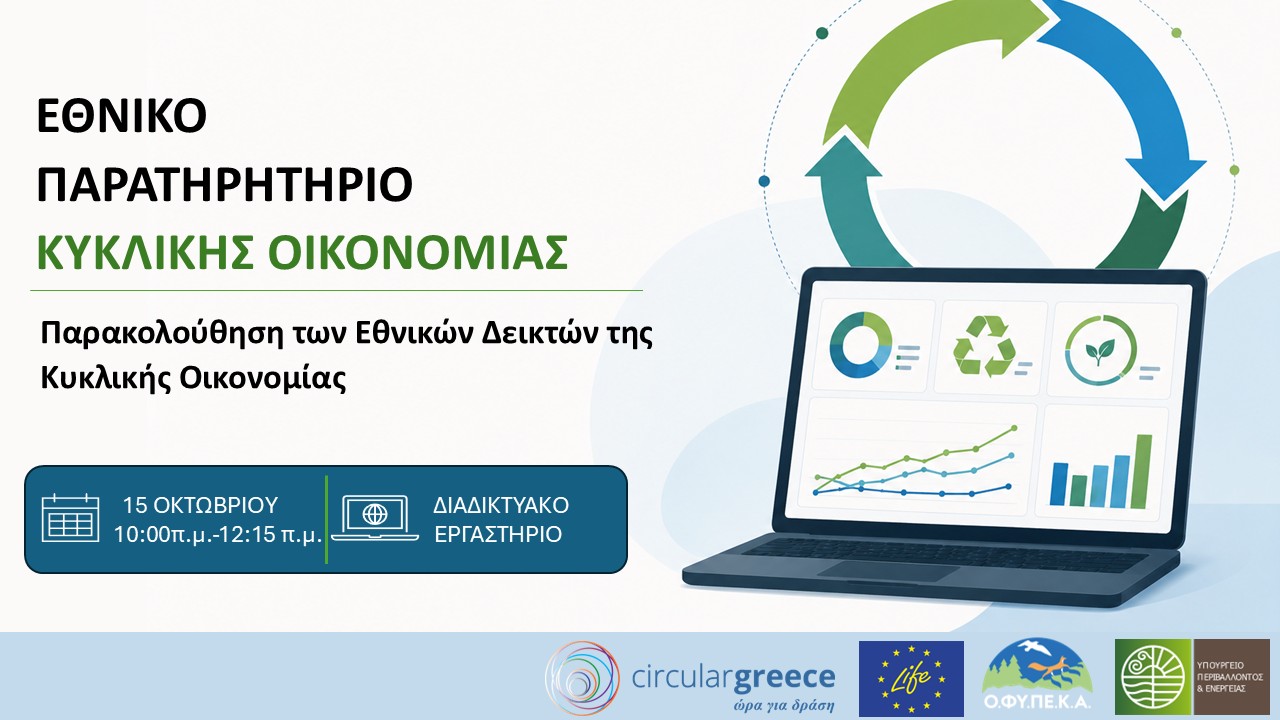
The contribution of the National Circular Economy Observatory to monitoring Greece’s progress towards a circular economy was the focus of a thematic online workshop held on 15 October 2026 as part of the LIFE-IP CEI-Greece project.
Organized by the Natural Environment and Climate Change Agency (NECCA) with the support of the Ministry of Environment and Energy (MEEN), which coordinates LIFE-IP CEI-Greece in Greece, the workshop attracted more than 300 academics and representatives of institutions, organiζations and businesses.
Focusing on monitoring and recording national circular economy indicators, the workshop highlighted the importance of establishing the Circular Economy Observatory, drawing on reliable data sources and cooperation among stakeholders.
The workshop opened with a presentation by Ioanna Anastopoulou, Project Manager at NECCA’s Department of Research Projects and Development Programmes Management. She stressed the need to develop indicators that better capture waste prevention, reuse, repair and the extension of product lifespans, linking the circular economy to the protection of natural resources and biodiversity.
Mary Plati, Project Manager of LIFE-IP CEI-Greece at MEEN, discussed the project’s contribution to the National Waste Management Plan, the National Waste Prevention Programme and the National Circular Economy Strategy. She referred to pilot waste management initiatives, the promotion of reuse and food waste prevention, as well as training and know-how transfer activities. Within this framework, she presented the National Observatory as a tool to support the circular transition.
Faye Nakou, MEEN expert for the project, presented the Observatory’s structure and capabilities. The Observatory, accessible at ceobservatory.com, collects and analyses data on resource use and efficiency, waste generation and management, the use of secondary raw materials, innovation and competitiveness, as well as energy, climate and water. Indicator data are displayed in both charts and tables and are available for download. Each indicator is also accompanied by the necessary metadata, presented through a protocol specifically designed for the national monitoring framework. This provides information on the indicator, its calculation method and the sources of the required data.
Kostas Papandreou, Head of the Energy and Environment Statistics Section at the Hellenic Statistical Authority (ELSTAT), presented data on waste generation and management and material flows in the Greek economy. He focused on domestic material consumption, resource productivity and import dependency—indicators that support the assessment of efficiency in the use of natural resources. He also highlighted data gaps and methodological challenges in developing waste accounts that reflect national circumstances.
Philippos Kirkitsos, President of the Ecological Recycling Society (ERS), a project partner, presented the ECO-Observatory, an initiative for the independent monitoring and assessment of progress in recycling and alternative waste management in Greece. He focused on developing evidence-based proposals for waste prevention, reuse and the separate collection of biowaste, with the aim of accelerating progress and reducing landfilling. He also discussed in detail the “Pay-As-You-Throw” scheme developed and piloted through LIFE-IP CEI-Greece in the Municipality of Vari–Voula–Vouliagmeni.
Dr Efi Tritopoulou, researcher at the National Technical University of Athens and Coordinator of the Environment Committee of the Technical Chamber of Greece (TCG), presented LIFE IP Zero WASTE Cyprus and the monitoring of circular economy indicators in Cyprus. Through comparisons with European performance, she highlighted the need to improve data recording and outlined the project’s activities supporting the implementation of the national circular economy strategy in Cyprus.
Finally, Katia Lazaridi, Professor in the Department of Geography at Harokopio University, a project partner, presented Greece’s experience in quantifying food waste. This indicator forms part of Eurostat’s circular economy indicator set and is gaining particular importance in view of the binding 2030 reduction targets under the revised Waste Framework Directive. She highlighted the importance of consistent methodology and quality checks in assessing waste prevention activities.
The workshop highlighted the role of the National Circular Economy Observatory as a reference point for monitoring Greece’s circular transition. With contributions from bodies such as MEEN and NECCA, the Observatory draws on data and publishes reliable reports that document progress and help inform the country’s next strategic steps.
Through the LIFE-IP CEI-Greece project, actions under the National Circular Economy Action Plan are being implemented to develop national indicators and establish an observatory for the continuous assessment of implementation progress.
Read here the Press Release
Find here the Workshop’s presentations.

